They come in through five doors
Web form, catalogue, phone, LinkedIn, email. Nobody has them all in one place.
B2B performance marketing
We generate demand with SEO, GEO, Google Ads, LinkedIn and Meta, and every lead lands in a CRM with its source attached. Your team rates it, we refine the qualification, and the good ones go back to Google Ads and Meta so your campaigns find more like them.
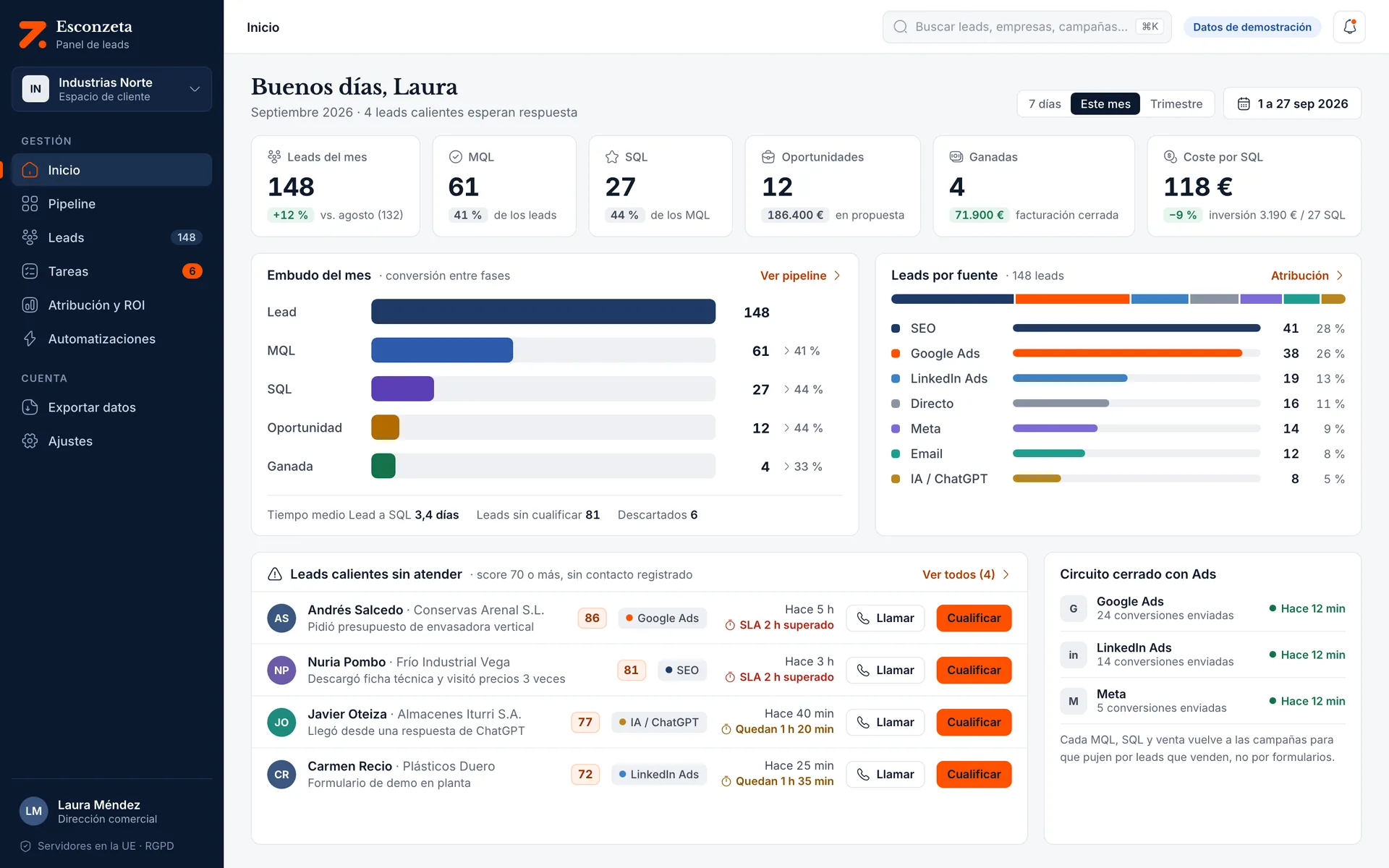
CRM screenshot with demo data from a fictitious company.
The problem
Web form, catalogue, phone, LinkedIn, email. Nobody has them all in one place.
They sit in "pending" until they go cold.
Google Ads counts form fills, not orders. It optimises towards what doesn’t sell.
One side says it sends leads; the other says they’re useless.
Standard performance
Esconzeta
It is our performance marketing service. We generate demand with SEO, GEO, Google Ads, LinkedIn, Meta and email, and every lead lands in our own CRM with its source attached. Your team rates each lead, we use those ratings to refine the qualification, and we upload the good leads and the sales to Google Ads and Meta so your campaigns optimise for revenue, not for form fills.
We capture
We qualify
We learn
The loop
Google Ads and Meta optimise towards whatever you tell them a conversion is. Tell them “form fill” and you get form fills. Tell them which leads are worth it and which ones bought, and they go looking for more like those.
Every lead arrives with its source: channel, campaign, keyword and landing page. If it came from ChatGPT, you see that too.
You rate each lead from 0 to 100% and add a comment. That is what no ad platform knows about your business.
We use those ratings to refine the scoring, so the next lead arrives better ranked and your sales rep calls the right one first.
We upload good leads and sales to Google Ads and Meta as conversions.
It stops optimising for form fills and starts looking for profiles similar to the ones that buy.
What we are after: higher-quality campaigns, better conversion and knowing which source actually brings in business.
Inside the CRM
What they searched for, which ad they saw, where they landed and whether they came from ChatGPT. With an explained score, your team’s rating in % and duplicates merged into a single record.
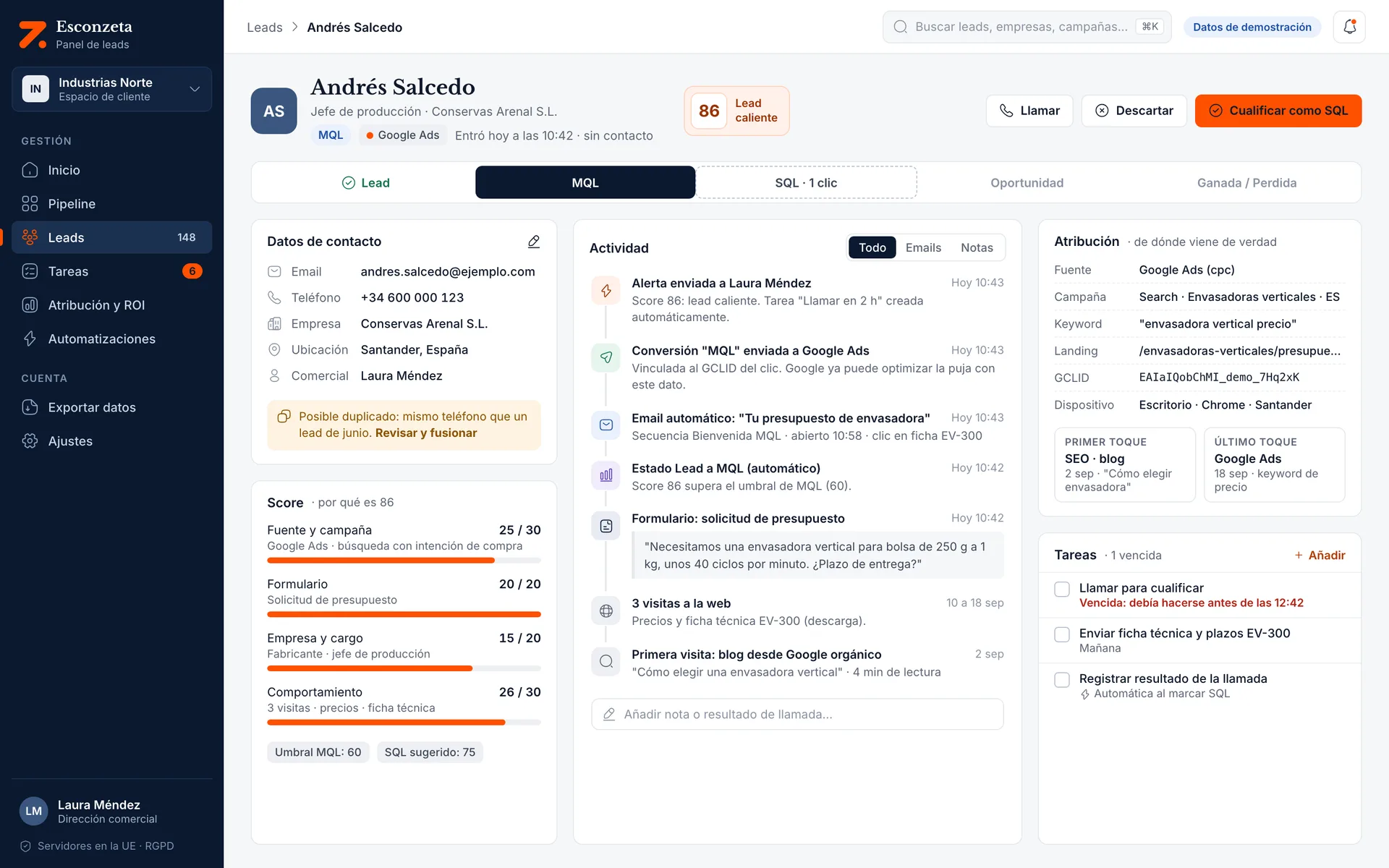
The screenshots come from the real CRM, filled with demo data from a fictitious company. If you also need GA4 and dashboards for leadership, we cover that in GA4 attribution and reporting.
Demand generation
In B2B every channel has a different job. We switch on the ones your buyer actually sees, not all of them for the sake of it.
SEO
Found by people already searching for what you sell. Traffic with buying intent, not volume.
Get named by ChatGPT, Perplexity and Gemini when your buyer asks.
Google Ads
Hot demand, bidding for customers, not clicks.
LinkedIn Ads
The exact job title, even before they start looking for you.
Meta Ads
Remarketing and lookalike audiences built on your won customers.
Email and CRO
Stay close to those not ready to buy, and make sure the landing page keeps those who are.
Comparison
| Classic lead agency | CRM on your own | Esconzeta | |
|---|---|---|---|
| Where leads live | Email or their own tool | Your CRM, if someone enters them | Your CRM, as soon as they arrive |
| Who qualifies | Nobody, or by gut feel | Your team, with no shared criteria | Agreed stages, sales decides |
| What Google Ads sees | Form fills | Form fills | Qualified leads and sales |
| You know which channel sells | No | Only if you set it up | Yes, by stage and channel |
| When you leave | You lose the history | You keep paying licences | You take everything in Excel |
Who it is for: manufacturing and distribution, B2B software and professional services, where each customer is worth a lot and a lost lead hurts. It is not for you if you want cheap contacts and have nobody to follow them up.
Method
Weeks 1-2
Where your leads come from, how many are lost and what your campaigns see. We define your ideal customer and stages.
Weeks 2-5
We connect forms and campaigns to the CRM, migrate your history and prepare conversions for Google Ads and Meta.
From month 2
Campaigns live, with a short weekly review with your sales team.
Every month
Cost per qualified lead, opportunities and sales by channel. We move budget towards what sells.
FAQ
It is an agency that brings you contacts from companies interested in what you sell. Most stop there: they deliver leads. We run the full performance marketing mix (SEO, GEO, Google Ads, LinkedIn, Meta and email), manage those leads in our own CRM, qualify them through stages and feed the good ones and the sales back into your campaigns.
A standard performance agency optimises clicks and cost per form fill. We follow every lead until it buys or is ruled out: we know where it came from, your team rates it and that rating goes back to Google Ads and Meta. The campaign learns which customer buys, not which visitor fills in forms.
An MQL (marketing qualified lead) fits your ideal customer profile and has shown interest. An SQL (sales qualified lead) has been validated by your sales team: there is a need, a timeline and a decision maker. Writing down where one ends and the other begins prevents most arguments between marketing and sales.
It adds points for fit (industry, company size, job title, region) and for behaviour (what they asked for, which pages they viewed). Your team also rates each lead in %, and we use those ratings to refine the score. Scoring orders the sales rep’s work; a person decides when a lead moves to sales.
They are sales or qualified leads that happen outside the website (in your CRM, on the phone, in a meeting) and are sent back to Google Ads or Meta. They let campaigns optimise for real customers instead of form fills, which is what they do by default.
In paid campaigns (Google, LinkedIn, Meta) there is usually a useful signal within 4-6 weeks and real optimisation from the second month. In SEO, 4 to 6 months for the first sustained movement. The more leads your team rates, the faster the campaign learns.
Yes. If you already use HubSpot, Salesforce or another CRM, we look at how to connect it during the diagnosis. If you have no CRM, your team works directly in ours.
It is yours. You can export it from the CRM at any time and, if you end the service, we hand over everything (contacts, history, sources and stages) in Excel or CSV and delete our copy within the period agreed in the data processing agreement.
The first step is a conversation.
No strings attached, no smoke.


